Let’s have a proper brew

Let’s have a proper brew
Let’s have a proper brew.
That imagery. That slogan.
I can’t get those words out of my head.
They sit there on the side of the Yorkshire Tea box, quietly confident, doing far more work than a cup of tea ever should. Superficially, the phrase seems perfectly innocuous, friendly even. But the longer I look at it, the more something about it nags. There’s a pressure in it. A familiarity that doesn’t feel entirely earned.
So let’s have a look, shall we?
But first (because Britain loves a lineage) let’s acknowledge the ideological weather system this box belongs to.
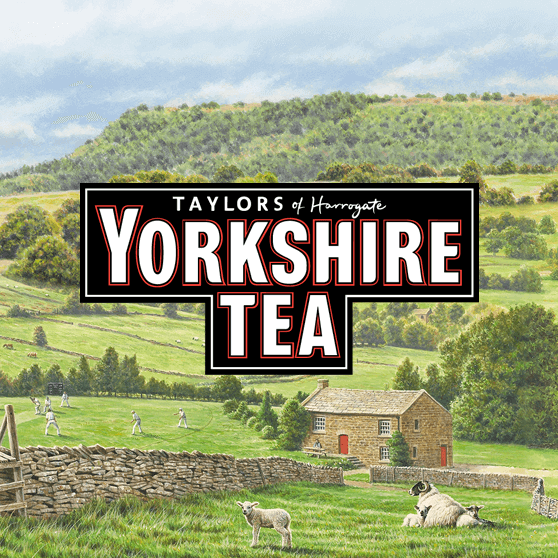
In 1993, John Major, then Prime Minister, described Britain as the country of long shadows on cricket grounds, warm beer, invincible green suburbs, dog lovers, and (borrowing from George Orwell) “old maids bicycling to Holy Communion through the morning mist.” It’s a vision of Britain as timeless, gentle, and consensual. A country that appears to have arrived fully formed, without conflict, industry, or inequality muddying the scene.
This is the same Britain the Yorkshire Tea box is selling. Just cheaper. And with teabags.
So… Back to the slogan.
Let’s
It all starts with an abbreviated form of the verb let and the plural pronoun us. It’s conversational; spoken language, informal, familiar. Like they’re talking to me. Like they’re my pal.
But they’re not my pal. (And who are “they”, anyway?)
To let is to allow. To permit. To sanction. It implies permission being sought or granted. But to do what? And granted by whom? Already, there’s a subtle imbalance here: an instruction masquerading as an invitation.
us
The absent plural pronoun. Who exactly is this us? Me and Yorkshire Tea? Me and the rosy-cheeked cricketers on the box? Me and my family? My colleagues? The nation?
The abbreviation nudges me toward the idea of communal tea drinking (a well-worn British cliché synonymous with pauses, breaks, shared moments of calm). At this early stage, I’m required to hold multiple meanings open at once, waiting to see which version of us the sentence will settle on.
I feel enticed. And wary.
The language is attempting to quietly envelop me within its logic, pitching itself as familiar, predictable, and reassuring. And we’re only one word in.
have
An irregular verb suggestive of possession, in the present or near future. What, then, am I (now provisionally part of this us) about to have?
The obvious candidates are the product itself or the experience of consuming it. But remember: this act of having has already required permission. Combined with the informality and the marketing context, I’m being steered toward something positive, comforting, and uncomplicated.
a
An indefinite article. The drumroll begins.
What follows will be a singular object or experience (contained, manageable, and familiar). The range of possibilities narrows. I can almost see it coming.
proper
And still the suspense grows.
The approaching noun is now adorned with the adjective proper, a term that carries far more baggage than it initially lets on. In one sense, proper might simply mean good or well-made. But that simplicity doesn’t hold for long. Proper only functions if there is something improper lurking nearby (an inferior version, a failed imitation?)
And in Britain, proper is never neutral. It’s a word thick with class, region, and value judgement. It gestures toward authenticity, toward doing things the right way. Often, though not exclusively, it carries the flavour of informal Northern English, where it can denote quality, heartiness, and moral soundness all at once.
So what is this singular, implicitly high-quality, culturally loaded thing we’re being invited (no, permitted) to experience?
By now, it’s clear that us was never just a small group. It’s all of us. All of us who drink tea. All of us who live here. All of us who recognise the codes (cricket, dry stone walls, sheep, weather).
Which is annoying, because I’ve never even been to Yorkshire.
brew
A brew. Of course it is.
A familiar British colloquialism for a cup of tea, and the final seal on the deal. If you know what brew means, you’re in. You belong. If you don’t, well, perhaps this wasn’t meant for you anyway.
The sentence resolves in a neat semantic crescendo: verb, pronoun, verb, article, adjective, noun. A slow reveal that leaves me implicated before I’ve had a chance to object. I understood every word long before I understood what they were doing.
And now the function of proper becomes unmistakable. It’s a pre-emptive swipe at competitors, at other teas, at other ways of doing things. An assertion of quiet superiority. A rebuke, delivered with a smile.
Burn.
Conclusion
All in all, what a manipulative little collection of words this is.
Paired with the twee, watercolour-rendered landscape on the box—rolling hills, timeless labour, a Britain seemingly untouched by industry or conflict—the slogan offers a linguistic accompaniment to a deeply romanticised idea of tradition and national identity.
So no, Yorkshire Tea. Let’s not have a brew.
There’s something grubby about this sentimental yearning for a Britain of yesteryear that never quite existed in the way it’s being presented here. The familiarity of the language isn’t accidental; it’s doing ideological work. It recruits through warmth. It disciplines through inclusion. It makes power feel like common sense and exclusion feel like bad taste.
This is language as soft governance, language that asks you to relax, put the kettle on, and stop asking awkward questions about who gets to belong, whose histories are being flattened, and which inequalities are quietly being stepped over in the name of comfort.
Granted, Yorkshire Tea isn’t alone in this. But by ‘eck, it’s particularly irritating.